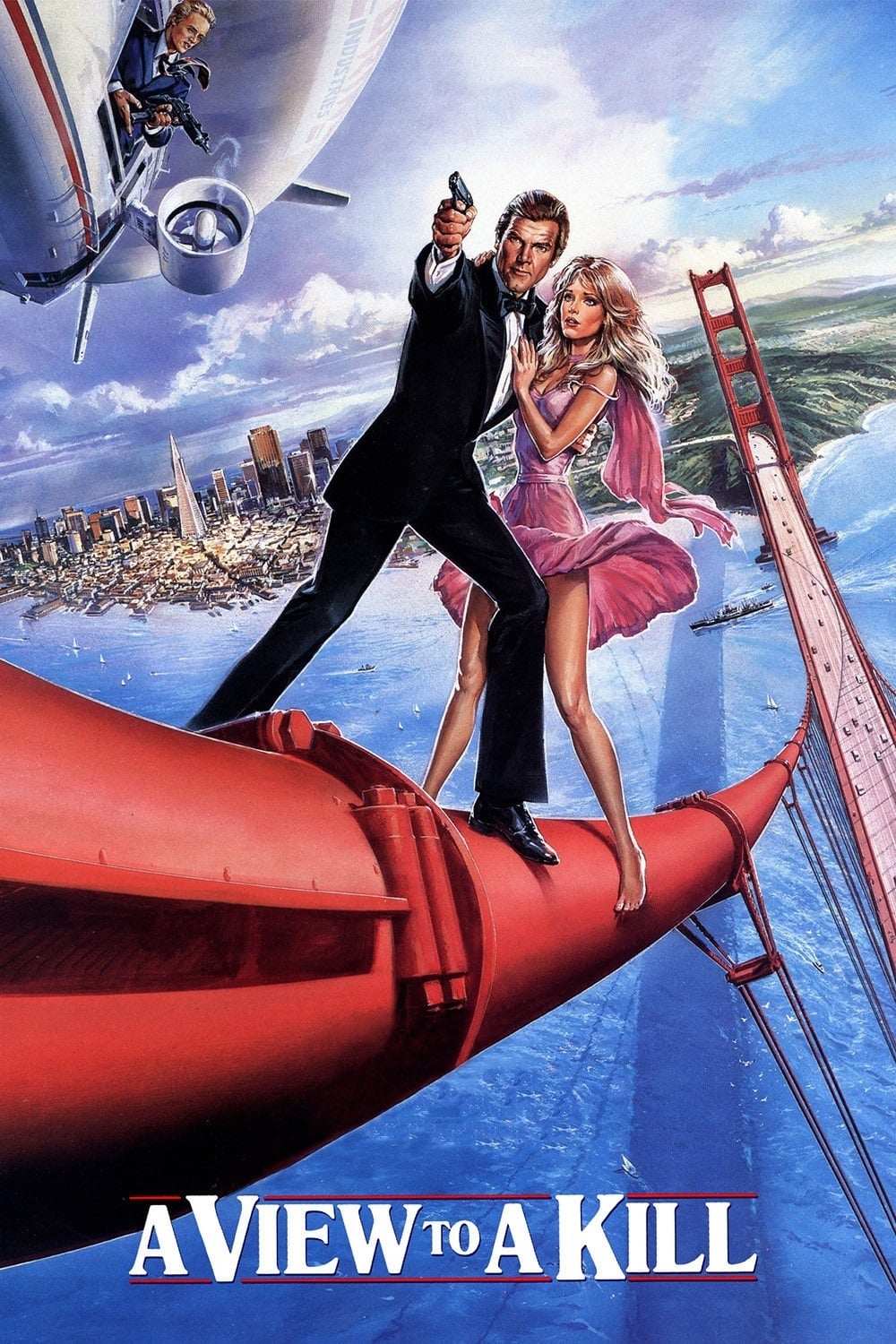
In the ending of A View to a Kill, Zorin falls to his death from the Golden Gate Bridge and his airship explodes, killing Dr. Carl Mortner and Scarpine. Spoilers follow.
The finale grows out of Zorin's plan to flood the area by detonating explosives under fault lines, which is why Stacey Sutton is left in the flooding mine. Zorin later takes her aboard his airship. Bond fastens the airship to the Golden Gate Bridge, and Stacey attacks Zorin to help Bond. Zorin is killed in a fight on the bridge and falls to his death.
Mortner dies when the airship explodes after dynamite is dropped in its cabin, and Scarpine dies with him. That removes the scientist behind the Nazi steroid experiment that, according to the CIA's Chuck Lee, probably produced Zorin, so the origin story and the scheme end together.
General Gogol then awards Bond the Order of Lenin. Gogol had scolded Zorin earlier for acting without permission, so the award closes the Soviet thread that began with the dead agent 003 and the stolen microchip in Siberia. It was Roger Moore's last outing as Bond, and the series moves on to The Living Daylights next.
How the climax was built. The airship in the final sequence was Airship Industries' Skyship 500, repainted with Zorin Industries markings, so the craft Bond ties to the bridge was a real aircraft dressed as the villain's property. AFI lists the Golden Gate Bridge climax among the San Francisco locations, alongside Fisherman's Wharf and City Hall. The City Hall fire engine escape, the mine flooding and the bridge fight therefore all play out in one real city, while the Pinewood interiors, including the rebuilt 007 Stage, were finished after the January 1985 reopening and before principal photography wrapped on 16 January 1985.
Where it sits in the series. A View to a Kill is the 14th official EON film, between Octopussy and The Living Daylights. Its ending is built on a split inside the Soviet camp: Gogol scolds Zorin for acting without permission, and the film then ends with Gogol honoring Bond. That is a different shape from the unofficial, non EON Never Say Never Again and Casino Royale (1967), which sit outside the EON numbering altogether.
Opinion. In my view, the Order of Lenin scene is the neatest piece of plotting in the film, because it answers the Siberian opening directly: the stolen chip that started the story ends up as the reason a Soviet general thanks the agent who recovered it.